
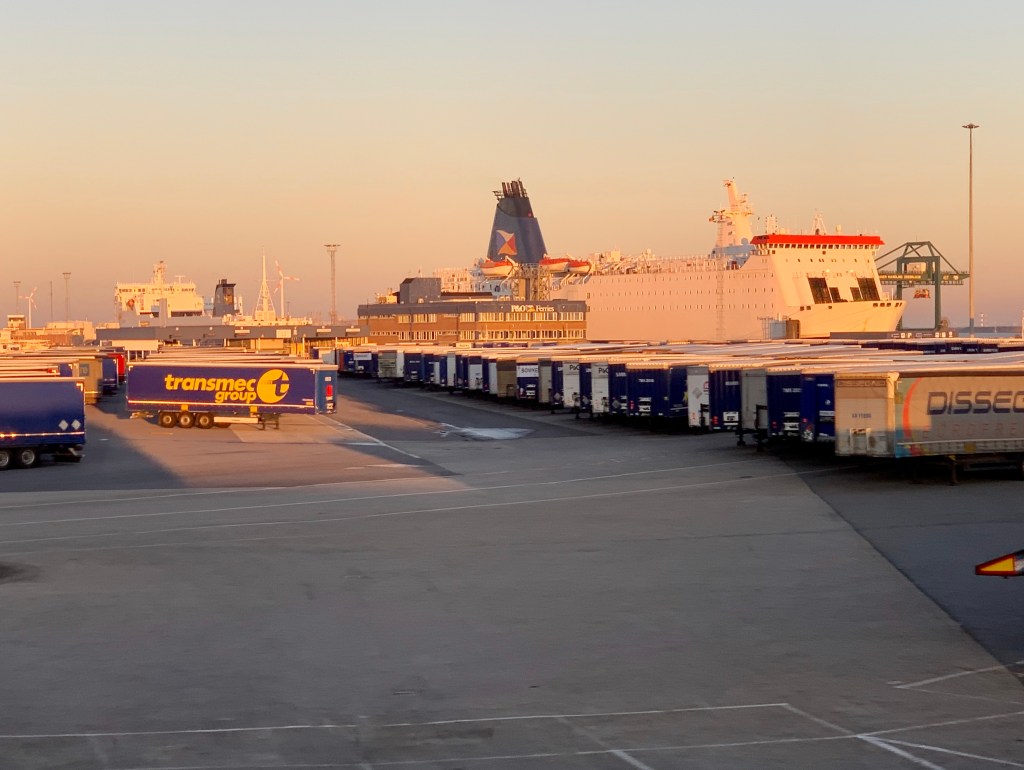
It was an inglorious end to a long and proud career. P&O Ferries Pride of Bruges has now joined her sister Pride of York in layup at Rotterdam close to the company’s passenger terminal. The future of the two ships hangs in the balance. At 34 years of age, the recently refurbished ferries are leaving service at the most difficult time for passenger shipping for many years. Future employment with a new operator isn’t guaranteed and being sold for scrap is a real possibility.
Passenger travel is obliterated by travel bans as a result of the Corona Virus and freight is struggling to move thanks to the UK leaving the EU and additional paperwork and checks being required to move goods. The Humber route in particular are somewhat vulnerable to the restrictions in movement of goods to Ireland from Europe, trade now using routes out of France and indeed Holland and Belgium direct to France avoiding the UK altogether.
It was quite sobering to see the Pride of Bruges arrive at the river berth in Hull devoid of passengers on the decks. The ship spent the last few weeks of her service with P&O covering for Pride of Hull which has now resumed service.
The Zeebrugge route was very popular with UK passengers travelling on mini cruises to Bruges although traffic has been declining for a number of years and replacement ships were clearly not viable which is a shame. The table below shows passenger numbers in thousands and whilst its clear both Hull routes saw large declines, the lower starting point of the Zeebrugge demonstrates a greater percentage drop in numbers.
| 2010 | 2011 | 2012 | 2013 | 2014 | 2015 | 2016 | 2017 | 2018 | 2019 | |
| Hull – Rotterdam | 593 | 603 | 587 | 527 | 575 | 562 | 560 | 559 | 538 | 536 |
| Hull – Zeebrugge | 357 | 368 | 360 | 349 | 354 | 333 | 312 | 279 | 312 | 292 |
It isn’t just passenger numbers of course, freight has always been important to keep these large ships viable and with more and more, larger and larger ships now operating into Europe from the Humber competition was always hot. Later sailings on faster ships had obvious advantages for freight too.
Replacing the Pride of Bruges and Pride of York would have required hugely costly infrastructure in the form of an additional river berth at Hull. The York and Bruges were both the largest ships capable of using the lock at Hull’s King George’s dock and it was quite the spectacle seeing them transit this on their way into or out of the docks.
Pride of Hull and Rotterdam on the Rotterdam service use the single river linkspan which was built for them and whilst the design of this allows for a second berth, it would not come cheap. Add this to the huge cost of building new ships and the figures clearly did not stack up.
And this is a shame, this was a useful overnight service from Northern England to the continent and whilst the Rotterdam route continues, adding the numbers of passengers using the former Zeebrugge route and the Rotterdam route together its plain to see that the Rotterdam may end up being a very busy service. The issue with that is the two ships on the service are nowhere near as capacious as the York and Rotterdam especially in the dining facilities – it will be interesting to see how this will play out in times to come.
It was the most quite of endings for the fantastic Pride of Bruges and Pride of York, a real shame. They have been part of the Hull landscape since 1987, you could spot their huge funnels from miles away into Hull. They will be missed.
 Ferry View